

In the industrial innovation lifecycle, there is a notorious gap between a successful lab experiment and a market-ready product. This “Valley of Death” is the stage where many promising clean-tech innovations fail due to the logistical, technical, and financial hurdles of scaling up. For IntensiCarb™, a revolutionary vacuum-enhanced anaerobic digestion technology, navigating this gap required a high-performance triad between USP Technologies, Trojan Technologies, and Lambton College.
“Since 2012, we have evolved from doing small, lab-based projects to what I call ‘deployment projects,'” says Mehdi Sheikhzadeh, Senior Vice President, Research and Innovation at Lambton College. “IntensiCarb™ is a transformative example that fits into that narrative by taking an idea from lab scale to pilot scale and full demonstration.”
The Innovation: Unlocking the Potential of Wastewater
The IntensiCarb™ technology addresses a massive economic and environmental burden. North American municipalities spend an estimated $2.5 billion annually to manage biosolids. IntensiCarb™ offers a way to “unlock” digestion capabilities, allowing for smaller, more effective digesters that can be fed at higher rates.
Technically, the process is a vacuum-enhanced anaerobic digestion system that improves hydrolysis and decouples solids retention time (SRT) from hydraulic retention time (HRT). This allows treatment plants to process more waste with a smaller physical footprint while recovering valuable byproducts, such as volatile fatty acids (VFAs) and ammonia. By shifting the focus from disposal to resource recovery, IntensiCarb™ aligns with global efforts toward a circular economy.
L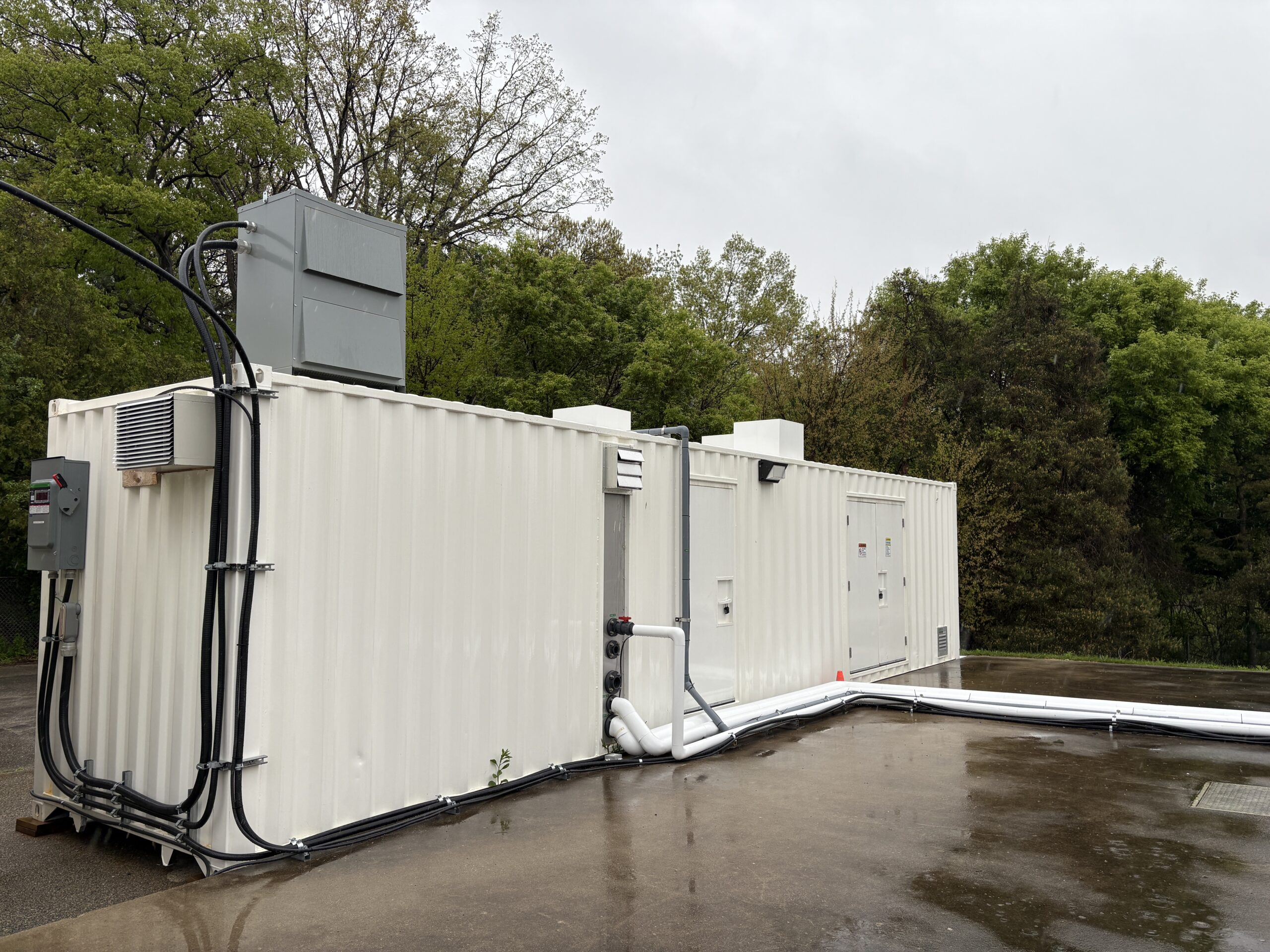 ambton College: The “Pillar of the Bridge”
While universities often handle early-stage theoretical research, industry partners Trojan and USP turned to Lambton for its hands-on, applied focus. Domenico Santoro, Director of Research & Innovation at USP Technologies, describes Lambton as a critical “pillar of the bridge” in the Valley of Death.
Santoro notes that for the critical validation and proof-of-concept phase, Lambton College functions effectively as a “one-stop shop.” In this stage, speed and multidisciplinary execution are paramount. “We would have a lab prototype that was 90% functional,” Santoro explains, “and the college would have the machine shop and the people with expertise in control to do the electrical wiring. It’s not theoretical expertise; it’s very much applied.” This agility allowed the team to rapidly generate the proof-of-concept data essential for filing patents and securing the corporate buy-in needed for scaling toward a full pilot.
The transition from bench scale to pilot scale was not just a matter of size, but of complexity. While the Lambton Water Centre provided the specialized hub for the project, the move to a pilot scale required a collaborative effort that drew on several of the college’s expert groups:
- Design & Fabrication: Utilizing their Water Scale-Up Lab within the Lambton Water Centre, researchers were involved in the system and process design, applying lessons learned from previous iterations to improve maintenance access and sampling protocols.
- Instrumentation & Control: Specialized research teams from the Lambton Manufacturing Innovation Centre were essential for managing the complex electrical and automated systems required to run the vacuum-enhanced process safely..
- Analytical Validation: Continuous data collection and rigorous testing were managed by the Bio-industrial Process Research Centre, providing the high-level data analysis required to confirm technology performance under real-world conditions.
A unique aspect of this collaboration was its remote nature. The pilot unit was not housed at the Lambton campus; instead, it was operated at the City of London’s Pottersburg Wastewater Treatment Plant. This required Lambton to manage complex municipal legalities, safety protocols, and a full HAZOP (Hazard and Operability) assessment.
This project showcased the college’s sophisticated approach to risk management and operational continuity. Because the pilot unit required 24/7 monitoring and maintenance, the Lambton Water Centre implemented rigorous oversight protocols to ensure the technology remained online and stable under all conditions. This ability to manage projects in the field, outside their immediate geographic area, has proven that Lambton can act as a technical lead for companies regardless of location.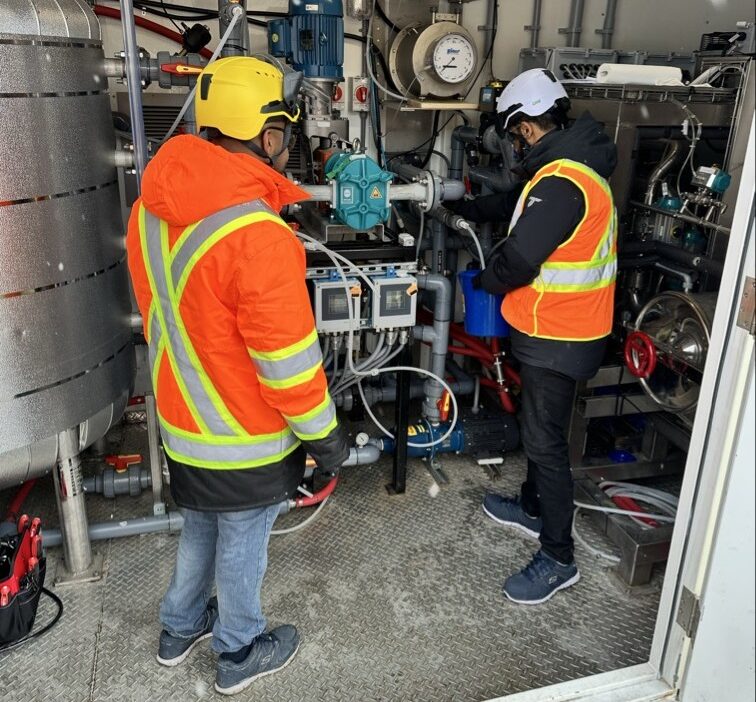
Beyond the technology, the partnership is building the future of the water sector. Chris Sheculski, Product Innovation Manager at Trojan Technologies, is a passionate advocate for the talent pipeline created by these projects.
“Forty people [at Trojan] are alumni of internships, Mitacs, and student programs,” says Sheculski. “These people are in all levels of our organization, all the way to director-level roles. It is a vital part of how we build the future of our organization.” By involving students in the day-to-day operation of the pilot, Lambton ensures that when IntensiCarb™ reaches full-scale deployment, there is an expert workforce ready to support it.
The Multi-Year Journey Toward Commercialization
While the vision for commercialization is clear, the partners recognize it as a long-term journey. Domenico Santoro explains that while the technology is conceptually ready, the team is currently navigating the “multi-year” technical challenges of a scale-up exercise. For USP, Lambton College serves as the critical “first pillar” across the Valley of Death, providing the validation needed to stimulate further R&D investment.
For Trojan, having a functional, validated pilot is the ultimate commercialization tool. Conservative municipal owners are often hesitant to adopt unproven technologies. “Most wastewater treatment plants want to see new technologies applied in their scenario to make sure it’s going to work for them,” explains Sheculski. “The pilot plays a critical role in the commercialization phase because you have this tool that you can then take to different wastewater treatment plants and get buy-in from those owners.” The strength of this partnership has already garnered significant industry recognition, with IntensiCarb™ being named a finalist for Water Canada’s 2025 New Tech Award.
The IntensiCarb™ project transforms the traditional view of a college; here, Lambton functions as a high-velocity applied research engine. By providing an integrated environment that combines fabrication, rigorous analytical chemistry, and complex project management, Lambton is helping industry partners move revolutionary ideas toward commercial realities.
“It is important to profile how the college system is doing large and complex projects,” concludes Sheikhzadeh. “The water sector is becoming increasingly aware of the resources available to them here.” As IntensiCarb™ continues its path toward full-scale deployment, it stands as a testament to the power of applied research in solving the world’s most pressing environmental challenges.
Partner with the Lambton Water Centre
The Lambton Water Centre is actively seeking industry partners to advance innovative water and wastewater technologies from validation to commercialization. Municipal utilities and other stakeholders exploring pilot-scale testing, applied research, or technology scale-up are also encouraged to connect.
To discuss collaboration opportunities, reach out through the Ontario Water Consortium or contact Carlos Diaz, Coordinator for the Lambton Water Centre directly.