

Ontario’s conservation authorities operate across watersheds with different forecasting capabilities, resources, and operational needs. Some have sophisticated hydrological models supporting their flood forecasting programs, while others rely more heavily on monitoring networks, weather forecasts, and the experience of staff who understand how their watersheds respond. That diversity has created an opportunity for HydroSphereAI, Aquanty’s AI-enabled hydrological forecasting platform.
Following a year-long beta phase involving conservation authorities across Ontario, HydroSphereAI is now moving into broader deployment through Conservation Ontario. The rollout represents an important step in Aquanty’s commercialization journey, while offering a practical example of what it takes to move technology from early adoption toward wider operational use. The foundation for HydroSphereAI was built several years ago, when Aquanty began adding machine learning capabilities to its physics-based hydrological modelling platform. With support from the Ontario Water Consortium’s (OWC) Water Industry Growth (WIG) Program, Aquanty advanced its machine-learning forecasting capabilities, including developing forecast algorithms and the infrastructure needed to incorporate detailed weather data. That work helped lay the foundation for what has become HydroSphereAI.
Today, the technology is being tested and deployed in the operational environments for which it was developed. Between February 2025 and February 2026, 19 Conservation Authorities participated in a HydroSphereAI beta program, providing Aquanty with feedback on the platform’s performance and how it could fit within real-world flood forecasting operations. Approximately 10 Conservation Authorities are continuing with HydroSphereAI through a more focused operational deployment. For Jag Phagura, Business Development at Aquanty, the process has demonstrated the importance of working closely with the sector. “We’re learning from the conservation authorities as much as they’re learning from us,” Phagura said.
The experience has helped Aquanty better understand the different forecasting approaches, resources, and priorities across Ontario, while refining how HydroSphereAI can complement existing systems rather than replace them. The Conservation Ontario rollout now provides a foundation for broader commercialization. That opportunity has also been strengthened by Rocscience’s acquisition of Aquanty, giving the company additional resources and market reach as it explores applications in Ontario and beyond.
Building Forecasts for the Real World
For Andre Erler, Senior Climate Scientist at Aquanty, one of the most important lessons has been the difference between developing a forecasting model and operating one in real-world conditions. HydroSphereAI combines machine learning with hydrological and environmental data and weather forecasts to provide streamflow predictions across large geographic areas. Its scalability means forecasting information can be provided across watersheds without requiring a fully calibrated physical model for every location. But operational forecasting introduces uncertainty that does not appear in the same way when testing against historical data.
Aquanty has therefore continued to refine the platform based on feedback and experience from Conservation Authority users. “We’ve learned a lot about what users actually need from a forecast,” Erler said. That includes moving toward shorter forecasting intervals while maintaining useful medium-range forecasts that can provide several days of advance indication of changing conditions.HydroSphereAI is also not intended to replace physics-based hydrological models. Instead, it provides complementary forecasting insight, particularly where organizations need scalable forecasting across larger areas. As Erler explained, “The idea is not that there is one model that does everything. It’s about providing another source of information.”
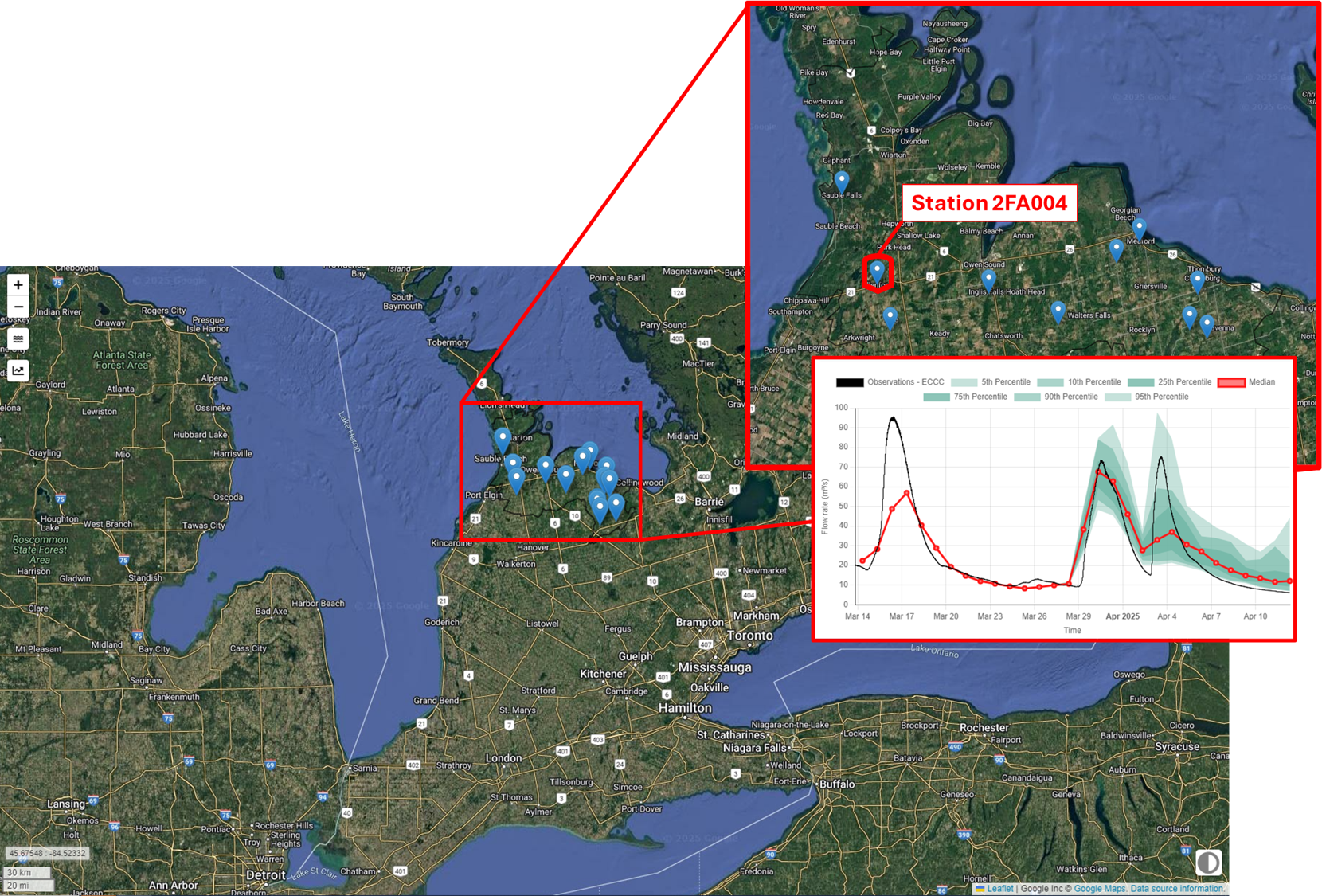
Forecasting algorithm output during the 2025 spring melt on the Sauble River, just outside the Maitland Valley Conservation Authority (MVCA) watershed.
For Maitland Valley Conservation Authority, HydroSphereAI has become another component of an existing flood forecasting process. Jeff Winzenried, Flood Forecasting Supervisor at Maitland Valley, explained that the authority has historically relied on monitoring data, weather forecasts, historical events, and staff experience to assess how its watershed may respond. HydroSphereAI offers a way to draw on that information more systematically and identify potential conditions that warrant closer attention. One of its most useful applications has been as a flagging tool. “If the forecast shows the potential for water levels to exceed our flood thresholds, we know where and when to start focusing our efforts,” Winzenried said.
That early indication can help the team focus monitoring efforts, assess particular areas of the watershed, and bring other forecasting tools into the analysis. Rather than relying on one model, Maitland Valley is moving toward an ensemble approach, comparing information from multiple forecasting systems. Agreement can increase confidence, while differences can highlight uncertainty and prompt further investigation. Integration is therefore critical to adoption. The forecasts need to be easily accessible and integrated into our existing workflow so we can compare them alongside our other forecasting tools. Seeing where independent forecasts agree can give us a degree of confidence in an expected watershed response. “If it’s not accessible, it won’t be used,” Winzenried said.
For all three perspectives, one lesson stands out: successful adoption requires time. A forecasting technology needs to be tested across different conditions and events before users can understand its strengths, limitations, and appropriate role in decision-making. During a significant spring freshet this past March, HydroSphereAI flagged the potential for elevated conditions at Maitland Valley. The forecasts were generally consistent with what the team was seeing through its other forecasting and monitoring systems, providing an important opportunity to build confidence in the technology. That operational experience is part of what moves a technology from promising innovation to trusted tool.
For Aquanty, the Conservation Ontario rollout represents the next stage of a development journey that began with building the underlying technology and validating its potential. The earlier support from OWC’s WIG Program illustrates the importance of that longer pathway. WIG funding helped Aquanty advance its machine-learning capabilities at a stage when dedicated resources were needed to develop the technology and supporting infrastructure. Today, that work is contributing to a platform being used in real-world flood forecasting operations. The Conservation Ontario rollout gives Aquanty an opportunity to build on those lessons.
The company continues to refine HydroSphereAI through user feedback and operational experience, while exploring applications beyond flood forecasting, including hydropower and mining. The broader lesson is equally important for the water sector. Moving innovation into practice requires more than developing advanced technology. It requires collaboration with users, integration into existing workflows, and enough real-world experience to build trust.
HydroSphereAI’s journey demonstrates what that process can look like: technology development supported through programs such as OWC’s WIG Program, testing with Ontario users, refinement through operational feedback, and increasingly broader deployment. As AI becomes more established in the water sector, creating those pathways from innovation to adoption will be just as important as developing the technology itself.