
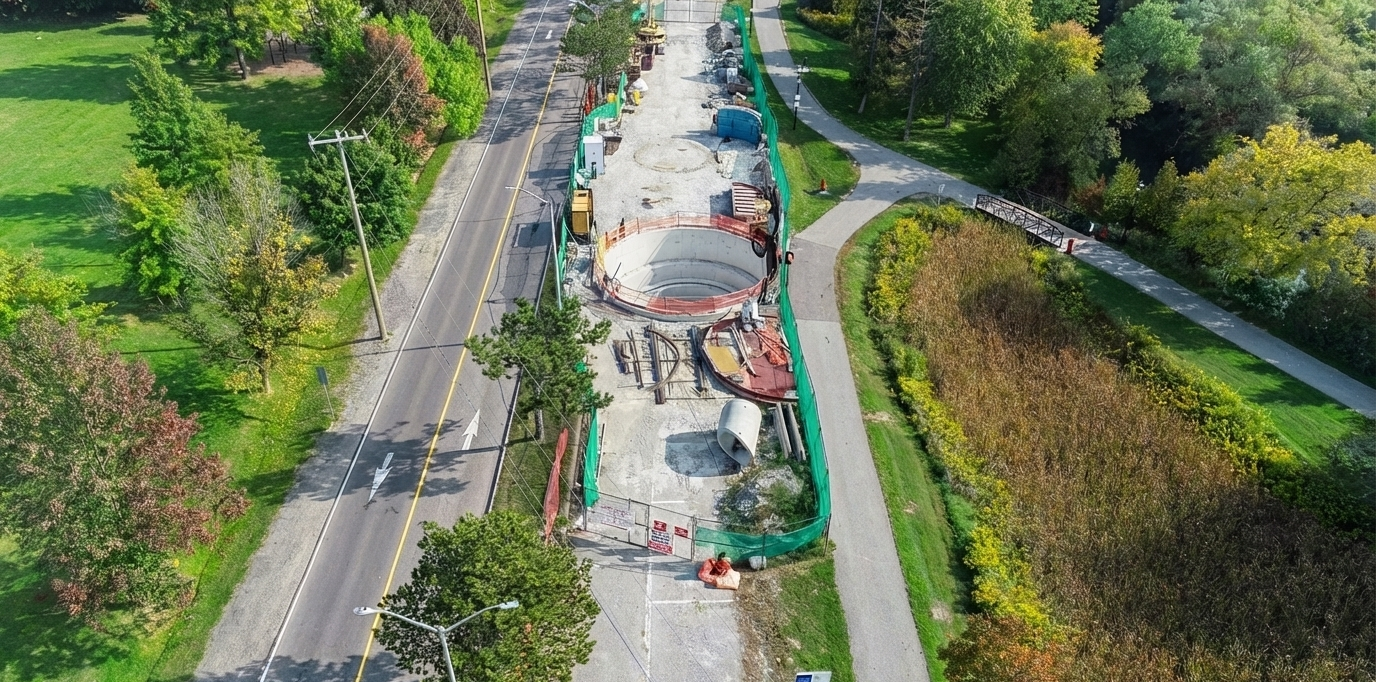
Across Canada, municipalities face the same hidden vulnerability: ageing wastewater infrastructure that has never been comprehensively inspected. Few assets illustrate this more clearly than large-diameter trunk sanitary sewers – the buried arteries of wastewater systems that often haven’t been assessed since installation.
Without condition data, utilities are forced into reactive maintenance cycles. Failures lead to emergency repairs, traffic disruption, and costly service interruptions. Recognizing the scale of this shared blind spot, four Ontario municipalities – York Region, Peel Region, Durham Region, and the City of Kitchener – joined forces to define the problem and invite innovation.
The Trunk Sewer Inspection Challenge, coordinated by the Ontario Water Consortium (OWC), sought deployable solutions capable of producing high-quality condition assessments in live, high-flow trunk sewers. Designed as a pre-competitive collaboration, it aimed not to procure a product but to surface promising technologies, exchange lessons, and identify paths toward pilot deployment.
The Challenge
Every participating utility described similar operational barriers. High-velocity flow and turbulence obscure camera views. Variable depths conceal cracks at the invert or crown. Long runs can exceed 100 metres, beyond the range of conventional closed-circuit television (CCTV) systems. Even during rare low-flow windows, access and safety constraints make inspection difficult.
Hundreds of kilometres of large sewers remain effectively “dark zones”: uninspected, unmapped, and poorly understood. Without reliable data, asset managers cannot quantify risk or plan rehabilitation with confidence.
As one engineer noted, these are critical assets we have never truly seen.
Emerging Solutions and Municipal Insights
Three shortlisted submissions offered contrasting approaches – each addressing a different facet of the problem.
- Multi-Sensor Integration Platform: A major engineering firm proposed a modular system combining laser and sonar profiling with acoustic leak detection and drone-based imaging. Its strength lies in integrating these sensing modes into a single 3D defect map aligned with standard defect coding.
- Autonomous Floating Vehicle: A Canadian start-up presented a self-propelled, low-draft vehicle using LiDAR-based mapping to maintain position in turbulent flow. The system operates without tethers, extending inspection windows beyond the narrow low-flow periods of conventional CCTV.
- Compact Submersible Crawler: A research-industry consortium proposed a tracked robot optimized for submerged conditions. Equipped with multi-beam sonar and inertial navigation, it is designed for adaptability and modular upgrades within existing inspection workflows.
Together, these concepts reflect a maturing technology landscape moving toward the same goal: turning trunk sewers from “no-data” assets into manageable, measurable infrastructure.
Across the sessions, several consistent themes emerged about what municipalities truly need and value. Municipal representatives repeatedly emphasized that the most valuable innovation is sometimes the simplest, especially when it provides visibility where none previously existed. As one participant observed, “innovation doesn’t always mean technically complex.” For utilities, the core challenge is “to be able to see where we can’t see.” A pilot example shared during the discussions involved a small floating camera unit that provided 8K video in high-flow conditions. While relatively basic, it offered crucial line-of-sight into inaccessible segments and allowed teams to decide where further investigation was warranted. This reinforced a central message: the first step toward intelligence is visibility.
Participants also cautioned innovators against focusing solely on automating standard defect coding such as the National Association of Sewer Service Companies (NASSCO) Pipeline Assessment and Certification Program (PACP). While helpful for inspection vendors, municipalities see greater value in tools that combine diverse data sources, linking LiDAR, infrared, and CCTV, to build confidence in structural condition. As one participant summarized, AI’s purpose is not just faster coding but “a better understanding of the infrastructure.” Screening tools that provide indicative insight, even if not fully NASSCO-compliant, were viewed as legitimate and valuable. What matters most is enabling better decisions about where to invest attention and resources.
Municipalities also highlighted the importance of integration and interoperability. Outputs that feed directly into asset management systems and deliver standardized, GIS-ready data have a far higher chance of adoption. At the same time, field crews need systems that are safe, deployable, and maintainable, rather than prototypes that require exceptional conditions or specialist support. Finally, collaboration was consistently cited as essential. By sharing experiences in a neutral forum, municipalities recognized that the inspection gap is not an isolated local issue but a systemic challenge best addressed collectively.
Implications and Recommendations
- Design for Deployment: Ensure crews can safely deploy solutions under real-world conditions.
- Integrate from the Start: Align data formats with existing GIS and asset-management tools to reduce friction in adoption.
- Demonstrate Decision-Making Value: Show how solutions guide investment and inspection priorities, not just capture data.
- Build Partnerships: Co-development and shared pilots accelerate trust and credibility.
- Enable AI-Driven Insights: Use inspection data to support predictive maintenance and digital twins at scale.
The Trunk Sewer Inspection Challenge also revealed a cultural shift. Municipalities are increasingly ready to engage innovators before procurement, test ideas collaboratively, and focus on practical field deployment rather than theoretical perfection. For the innovation community, the message is clear: the market is looking for pragmatic, interoperable tools that make invisible infrastructure visible safely, affordably, and at scale. For OWC, this reaffirmed the importance of neutral coordination, convening partners, distilling insights, and connecting need with capability across the water innovation ecosystem.
Next Steps
Following the roundtables, participating municipalities are exploring pilot opportunities and shared validation protocols. OWC will continue to coordinate these efforts and welcomes additional municipal or industry partners interested in advancing this work.
In addition, municipalities are invited to reach out with other water or wastewater challenges they are facing, which could benefit from collaboration, knowledge-sharing, or future initiatives.
Interested organizations may contact Robert Nyman, Manager, Partnerships & Programs, at robert@ontariowater.ca