
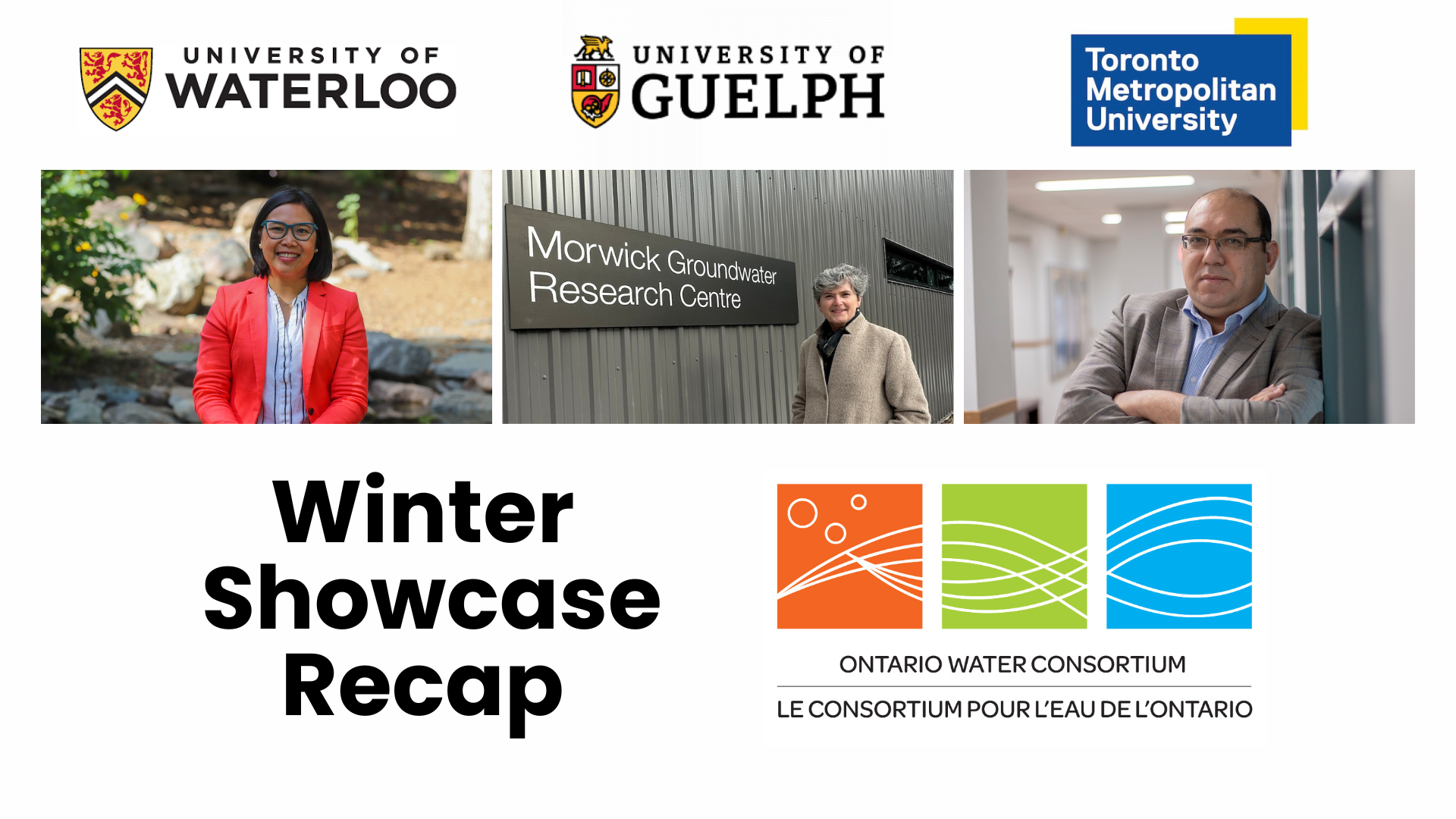
This winter, the Ontario Water Consortium hosted its Innovation Showcase Winter 2026 Series, a three-part webinar program highlighting applied research and collaboration across Ontario’s water sector. Attendees from academia, government, and industry explored strategies to manage trace organic contaminants, monitor fractured bedrock groundwater systems, and mitigate fugitive methane emissions from wastewater treatment plants.
The series opened with the University of Waterloo, where Dr. Maricor Arlos and her team at the Arlos Research Lab shared emerging approaches to understanding and mitigating organic chemical contamination. Dr. Arlos highlighted pathways of exposure and strategies to safeguard water quality and ecosystem health. Jingya Pang (PhD student) discussed using bauxite residue as an innovative adsorbent for removing trace organic contaminants. Melissa Bennett (MASc student) presented integrated hydrological and ecological modeling of pesticide fate and bioaccumulation. Mackenzie Rosebrugh (MASc student) showcased effects-based bioanalytical tools to assess stormwater impacts in Calgary’s Glenmore Reservoir. The session demonstrated how multidisciplinary tools can strengthen source water protection and ecosystem health.
The second session featured researchers from the University of Guelph and the Morwick G360 Groundwater Research Institute, focusing on fractured bedrock aquifers at the energy–environment–water interface. Dr. Beth Parker outlined an integrated workflow for characterizing bedrock aquifer flow systems to enhance municipal source water protection and remediation. Dr. Ferdinando Manna examined vulnerabilities in aquifers associated with low-temperature geothermal operations, highlighting monitoring strategies to support responsible development.
The series concluded with a Toronto Metropolitan University-led session on fugitive methane emissions from wastewater treatment plants. Dr. Elsayed Elbeshbishy (TMU) discussed monitoring approaches and challenges in quantifying emissions. Amr Ismail (PhD student, TMU) presented a full-scale case study, using modeling to identify influential emission sources and reduce uncertainty. Dr. Ahmed Al-Sayed (Western) contributed on the role of plant-wide models as diagnostic tools for emission estimation. The session highlighted how combining monitoring and modeling supports both operational performance and environmental management.
Across all three sessions, a common theme emerged: Ontario’s water innovation ecosystem thrives on collaboration, advanced tools, and integrated research. From managing trace organics and protecting groundwater to reducing greenhouse gas emissions, these initiatives show how applied research translates into practical solutions and policy impact.
Watch the Webinars
Recordings from the Winter Series are now available:
- Charting a Course for Clean Water: Mitigating Organic Chemical Contamination in the 21st Century
Presented by Dr. Maricor Arlos, Jingya Pang (PhD student), Melissa Bennett (MASc student), Mackenzie Rosebrugh (MASc student) – University of Waterloo
Watch the recording › - Advancing Bedrock Groundwater Monitoring at the Energy–Environment–Water Interface
Presented by Dr. Beth Parker, Dr. Ferdinando Manna – University of Guelph / Morwick G360 Groundwater Research Institute
Watch the recording › - Plant-Wide Model of Wastewater Treatment: A Diagnostic Tool for Fugitive Methane Emissions
Presented by Dr. Elsayed Elbeshbishy (TMU), Amr Ismail (PhD student, TMU), Dr. Ahmed Al-Sayed (Western) – Toronto Metropolitan University & Western University
Watch the recording ›
What’s Next
Building on the Winter Series, OWC will host its Summer 2026 Innovation Showcase in June, continuing to spotlight academic research, technological innovation, and partnerships driving water innovation across Ontario. Subscribe to the OWC newsletter to stay informed about upcoming sessions.
Subscribe to the OWC newsletter to stay informed about upcoming sessions and opportunities to connect with Ontario’s water innovation community.